
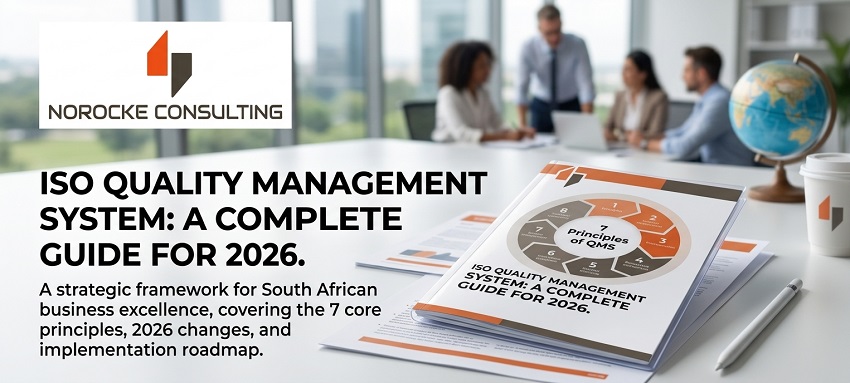
An ISO Implementation for Quality Management System (QMS) is a formalized framework of policies, processes, and documented procedures designed to help organizations consistently deliver products and services that meet customer and regulatory requirements.
While “ISO QMS” can refer to several industry-specific standards, the universal global benchmark is ISO 9001, which is currently transitioning into its highly anticipated ISO 9001:2026 edition.
An ISO QMS relies on a continuous loop of optimization known as the PDCA Cycle (Plan-Do-Check-Act). It ensures that organizational knowledge, risk-based thinking, and operational control are institutionalized rather than left to chance.
The 7 Core Principles of ISO Quality Management
To build a resilient QMS, ISO mandates adherence to seven foundational principles.
| Principle | Core Operational Objective |
| 1. Customer Focus | Aligning organizational goals directly with customer expectations and measuring satisfaction. |
| 2. Leadership | Establishing unity of purpose; top management must actively drive the quality culture. |
| 3. Engagement of People | Empowering competent, respected, and involved professionals across all levels. |
| 4. Process Approach | Managing interrelated activities as a cohesive system to optimize efficiency. |
| 5. Improvement | Maintaining an ongoing institutional focus on identifying and reacting to breakthroughs or errors. |
| 6. Evidence-Based Decision Making | Analyzing real-time data and metrics rather than relying on historical assumptions. |
| 7. Relationship Management | Optimizing relationships with suppliers, partners, and external stakeholders. |
What’s Changing? ISO 9001:2015 vs. ISO 9001:2026
The ISO standard is evolutionary. As businesses adapt to technological shifts, the QMS framework must keep pace. The latest ISO 9001:2026 revision introduces several critical pivots that modern organizations must implement:
-
Explicit Quality Culture & Ethics: Top management is now audited on how they actively foster an ethical, quality-first culture, moving beyond just signing off on paperwork.
-
Formalized Knowledge Management: With the rise of AI and rapid labor shifts, protecting organizational knowledge and internal data as a critical business asset is now mandatory.
-
Separation of Risks and Opportunities: While previous frameworks blended them, the latest system demands distinct, measurable pathways for mitigating risks versus capitalizing on opportunities.
-
Digital Transformation & Resilience: Greater emphasis is placed on how a QMS handles digital workflows, remote/hybrid environments, and supply chain disruptions.
How to Implement an ISO Quality Management System
Setting up a certified QMS requires structured governance. Misordering these steps can result in an operational disconnect or a failed certification audit.
1.Define Context & Scope:
Core Business Benefits of ISO QMS Certification
-
Tender & RFP Eligibility: In many global industries (aerospace, medical, manufacturing), holding an ISO 9001 certificate is a hard prerequisite to bid for contracts.
-
Reduced Operational Waste: Standardized processes dramatically reduce manufacturing defects, rework time, and service errors, passing direct savings to the bottom line.
-
Seamless Framework Integration: Thanks to the Harmonized Structure (HS), an ISO 9001 QMS shares the exact same framework as ISO 14001 (Environmental) and ISO 45001 (Health & Safety), allowing companies to build a singular, integrated management ecosystem.