
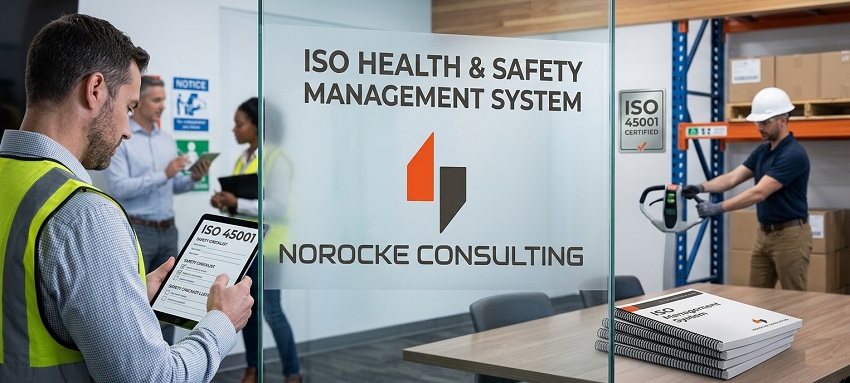
If you’re researching a health and safety management system, you’ve probably seen ISO for health and safety come up. That’s because ISO 45001 is the global standard that helps organizations protect workers, reduce risk, and meet legal duties.
This guide breaks down what it is, why it matters, and how ISO implementation for health and safety management system works in the real world.
What Is an ISO Health and Safety Management System?
An ISO health and safety management system is a structured framework based on ISO 45001:2018, the international standard for Occupational Health and Safety Management Systems (OHSMS).
Unlike ad-hoc safety programs, ISO 45001 gives you a repeatable, auditable process to:
- Identify workplace hazards and assess risks
- Comply with OH&S legal requirements in your country
- Reduce incidents, injuries, and work-related ill health
- Create a culture of safety driven by leadership and worker participation
It replaced OHSAS 18001 and is built to integrate easily with ISO 9001 for quality and ISO 14001 for environment.
Why Companies Implement ISO 45001 for Health and Safety
Searching for ISO for health and safety usually means you want results. Here’s what certified organizations report:
|
Business Benefit |
Impact of a Health and Safety Management System |
|---|---|
|
Fewer incidents |
Proactive risk control cuts lost-time injuries by 20–40% on average |
|
Legal compliance |
Systematic tracking of OH&S laws reduces fines and enforcement action |
|
Lower costs |
Less downtime, lower insurance premiums, reduced absenteeism |
|
Tender eligibility |
Many governments and corporates require ISO 45001 from suppliers |
|
Staff retention |
Workers trust companies that invest in their wellbeing |
Core Elements of ISO 45001: The PDCA Approach
ISO implementation for health and safety management system follows the Plan-Do-Check-Act cycle. Here’s what that looks like:
1. Plan: Context & Risk Assessment
- Understand internal/external issues that affect safety
- Identify hazards: machinery, chemicals, ergonomics, psychosocial risks
- Determine legal requirements for your industry and region
- Set measurable OH&S objectives — e.g. “Reduce manual handling injuries by 25% in 12 months”
2. Do: Leadership, Support & Operation
- Top management must lead and provide resources
- Workers participate in hazard identification and safety decisions
- Train staff for competence, not just compliance
- Control operational risks and prepare emergency response plans
3. Check: Performance Evaluation
- Monitor, measure, and audit your health and safety management system
- Investigate incidents and near-misses to find root causes
- Conduct management reviews to check if objectives are met
4. Act: Continual Improvement
- Fix nonconformities and update processes
- Use data to prevent recurrence and improve safety performance
ISO Implementation for Health and Safety Management System: 7-Step Roadmap
If you’re planning ISO implementation for health and safety management system, use this practical sequence:
- Get Leadership Commitment
ISO 45001 fails without visible top-management support. Define roles, allocate budget, and communicate the “why.” - Conduct a Gap Analysis
Compare your current safety practices against ISO 45001 clauses. This shows exactly what to build, fix, or document. - Engage Workers Early
The best hazard insights come from the shop floor. Set up a safety committee and anonymous near-miss reporting. - Document What Matters
You need a policy, risk assessments, legal register, objectives, and procedures for emergency response. Avoid paperwork for its own sake — ISO 45001 is about control, not folders. - Train and Roll Out
Everyone needs to know their role in the health and safety management system. Run toolbox talks, drills, and competency checks. - Internal Audit + Management Review
Test the system before certification. Are controls working? Are we meeting objectives? Fix gaps now. - Certification Audit
An accredited body conducts Stage 1 (document review) and Stage 2 (on-site audit). Pass both and you’re certified for 3 years, with annual surveillance audits.
Do You Need ISO 45001 Certification?
No — you can use ISO for health and safety as a best-practice framework without certification. But certification gives you:
- Independent proof for clients and regulators
- Competitive edge in tenders and supply chains
- Structured external feedback to improve
Small businesses often start with “self-declared conformity” and move to certification as they grow.
Common Mistakes to Avoid During Implementation
- Treating it as a paperwork project — If it doesn’t reduce real risk, it’s not working.
- No worker involvement — ISO 45001 mandates consultation. Skip it and you’ll fail audits.
- Ignoring psychosocial risks — Stress, harassment, and burnout are now part of OH&S scope.
- “Set and forget” after certification — The standard requires continual improvement.
Who Should Use an ISO Health and Safety Management System?
Any organization, any size. It’s common in construction, mining, manufacturing, logistics, and healthcare — but even offices and NGOs in Soweto and globally use ISO 45001 to manage risks like fire, ergonomics, and mental health.
Final Word: Safety as a System, Not a Slogan
A strong health and safety management system turns good intentions into consistent action. ISO for health and safety gives you the structure. ISO implementation for health and safety management system gives you the results: fewer injuries, legal confidence, and a workplace where people thrive.
Next step: Download the ISO 45001 clause structure and map it against your current safety controls. You’ll know in 30 minutes how close you already are.
FAQ: ISO Health and Safety Management System
Q: What’s the difference between ISO 45001 and OHSAS 18001?
ISO 45001 focuses more on leadership, worker participation, and risk-based thinking. OHSAS 18001 was procedure-heavy; ISO 45001 is performance-focused.
Q: How long does ISO implementation for health and safety management system take?
For an SME with some safety processes already: 4–8 months. For larger or high-risk operations: 9–18 months.
Q: Can ISO 45001 be integrated with ISO 9001 and 14001?
Yes. All use the same Annex SL structure, so you can run one integrated management system instead of three separate ones.